Some careful analysts have been declaring a victory for Iran for several days already. Pres. Trump and Poppinjay Pete (Hegseth) have been declaring victory for the U.S. My judgment is closer to that of the “victory for Iran” people– although (1) the war is by no means over yet, and (2) the cost imposed on the peoples of Iran, Lebanon, and Palestine is, and will continue to be, horrendous. Here anyway, are my four current key takeaways, with more explanation below:
The Islamic Republic of Iran has been holding up well. Its central decisionmaking structure remains in place and it’s been pursuing a smart, long-prepared plan for dealing with this assault.
The stakes in this contest are global. The IRI deliberately globalized it from the first hours. China has an irreplaceable role in any termination or substantial de-escalation of the conflict. This affects the entire balance of geopolitics.
The planning, execution, and nature of the Israeli-U.S. assault on Iran have been closely tied to (and grown out of) the Abraham Accords. The failure of the assault should now lead to the end of those accords.
The choices that GCC leaders make over the coming days will be crucial.
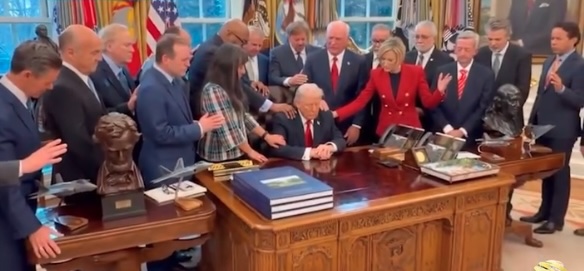
(The photo shows Trump being prayed over in the White House yesterday by a group of evangelical pastors.)
Today is Day 7 of this mass-murdering, mass-destruction project that Pres. Donald Trump named “Operation Epic Fury” (OEF). Already, the dimensions of many of its (quite foreseeable, and by many people clearly foreseen) consequences are becoming evident.
Most crucially, as of today, these:
The Iranians’ governance and command structure has survived, despite “decapitation” strikes since its first hours that killed Supreme Leader Khamene’i and dozens of top commanders.
Iranian forces continue, in response to OEF, to undertake stand-off attacks that seem well aimed and well coordinated and have in many cases inflicted real damage on their intended (military and economic) targets.
Israel has exploited this situation of war, impunity, and lawlessness to (a) reimpose its super-tight siege on the two million people of Gaza, (b) sharply escalate its bombings of Lebanon and peremptorily order the ethnic cleansing of South Lebanon as well as Beirut’s densely populated southern suburbs, and (c) continue to oppress and dispossess Indigenous inhabitants of both the West Bank and Syria.
The Iranians’ response to OEF has included attacks not just on Israeli and U.S. military bases across West Asia but also on key economic facilities in Arab Gulf countries.
Through those latter attacks and by closing the Straits of Hormuz to shipping from OEF-associated countries, Tehran has delivered a huge blow to the global economy and especially to the Gulf Arab states that have been major bankrollers of Trumpian projects worldwide.
There are still, as of now, no signs of any imminent collapse of Iran’s command/governance structure. And meanwhile, all around the world a chorus of questions is growing louder around two key issues, either of which could rapidly increase the pressure on Washington to end the war. The first such pressure-point is the durability of U.S. stockpiles of key missile-defense and air-defense munitions needed to fend off Iran’s continuing volleys of low-cost drones and high-altitude missiles. The second is the degree, speed and temporal extent of the damage that the war inflicts on the global economy– a process that has already started.
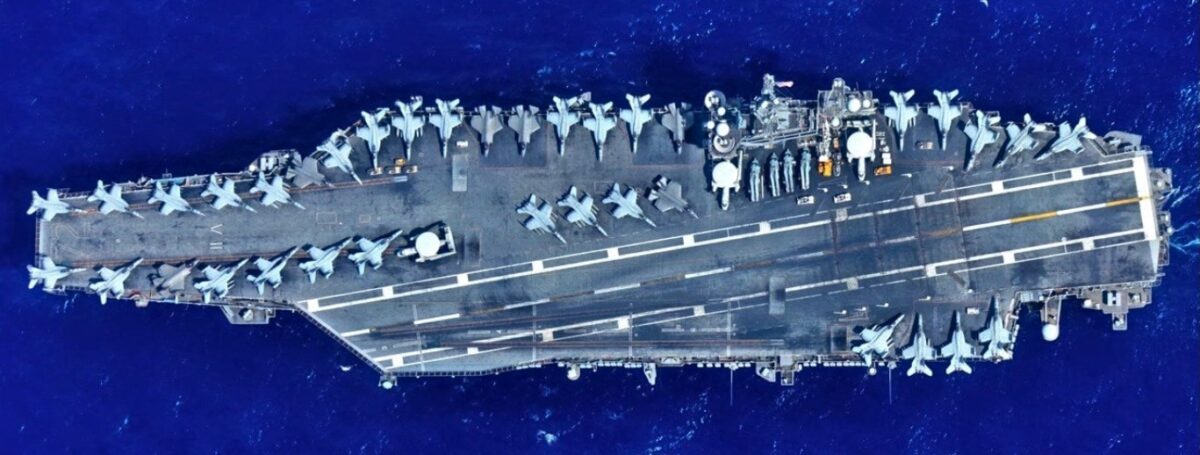
The Trump administration has now ordered a second Carrier Strike Group to join the one that is already sailing in the Gulf of Oman, close to Iran, and has deployed large amounts of military equipment (both offensive and defensive) to U.S. bases across West Asia, and to Israel. Trump’s envoys have now had two rounds of “proximity talks” with Iranian counterparts this month, discussing new limitations on Iran’s nuclear enrichment program.
Both sides have said those talks went fairly well. But Washington now expects Tehran to present more detailed plans by March 3 and Trump has warned that if Iran fails to reach a satisfactory agreement, then it will face very serious military consequences.
Some analysts have gauged the probability of an all-out war at “80 to 90 percent.” Such numbers are still wildly speculative (and personally I would peg them far lower than that.) But in assessing the possibility of any major military engagement between the U.S.-Israeli alliance and Iran it is crucial also to assess the range of outcomes and knock-on effects that we can plausibly foresee from any such conflict, at a number of different levels:
within the immediate theater of the conflict (Iran, the Gulf region)
in the Mashreq (Levant) region which has Israel at its geographic core, and specifically, on Israel’s ability to continue imposing its diktat on its neighbors in the region, and
on the stability and integrity of the global system as a whole.
In this essay, I shall review the record of the project to weaken or topple Iran’s current, 47-year-long system of governance that the Trumpists and the government of Israel have jointly pursued in the period since Trump’s victory in the 2024 election, and identify six key takeaways we can take from that review.
In a later essay, I plan to build on this analysis to provide a few preliminary guidelines for what the effects of any new Trump-Israel assault on Iran might be, at the three levels identified above.
On July 1, Sina Toossi published an important piece in Foreign Policy mag in which he argued that the “12-day war” that the US-Israeli alliance launched against Iran on June 13 had backfired, primarily in terms of its nuclear-nonproliferation goals. He wrote:
There is no question that Israel achieved notable tactical successes, inflicting serious damage on Iran’s military command and scientific infrastructure. But … based on available evidence, Netanyahu’s core goals—undermining Iran’s deterrence and meaningfully rolling back the elements of its nuclear program that pose the greatest proliferation risk—remain unmet.
One of the most significant failures lies in the nuclear file…While Trump administration officials have insisted that the strikes set Iran’s program back by years, early U.S. and European intelligence assessments suggest otherwise.
On July 8, Israeli military/intel analyst Moty Kanias followed up with this analysis, along similar but notably broader lines. Here were his heading and subhead:
London-based security analyst Mark Sleboda gave one good initial summary of the takeaways from this war, as summarized here by Bernhard of Moon of Alabama.
I agree with most of Mark’s points, especially his bottom-line conclusion that the biggest loser was “the NPT and international law.” We’ll come back to that, later.
Here are just some quick clarifications on Mark’s point that the US and Israel came to realize that a war of attrition “was going to go badly for Israel”:
People who consume mainly western corporate media need to understand that they have NOT gotten anything like the full picture of the damage that Iran’s strikes have caused to Israel’s society and economy. All foreign media reporting from Israel is subject to very strict military censorship, as I know from experience. None of the journos for Western corporate media who report from Israel tells their viewers/readers that. Shame on them!
In a small slip, the Israeli Tax Authority recently released (but then speedily deleted) some docs reporting that as of yesterday they had already received 32,975 claims for damages to buildings. The Twitter account of MENA Unleashed reproduced some parts of this Israeli Tax Authority report. You can read their whole analysis of this and other damage data from Israel here.
The Electronic Intifada’s indispensable Jon Elmer also presented a great assessment on June 20 of how the war was going for Israel, by then. You can see his 31-minute here, or read a transcript here. (The still photo above is from his report.)
Mark Sleboda wrote that the Iranian government had agreed to Trump’s ceasefire proposal “because they too have been badly shaken through Israeli covert warfare and their own air defense all but collapsed.” The first part of that assessment is almost certainly true, given that on the first day (Friday the 13th) of Israel’s massive initial assault, Israeli covert ops succeeded in killing more than a dozen key, top IRGC leaders and commanders, and top nuclear scientists.
However, after many decades of facing different types of attack from Washington, Israel, and their allies, the Iranians have become very accustomed to building redundancy and resilience into their command and control networks. And within just a few hours of Israel’s atrocious and quite illegal sneak attack, Iranian units were able to send 100 missiles against Israel on that first day, and then to maintain the capability to shoot missiles and drones against Israel until the very day of the ceasefire, June 24.
The image here, taken from the Haaretz website, lists just the 532 ballistic missiles that Iran sent against Israel during the war, not those low-level drones that also got through. It indicates that 31 of the missiles managed to evade Israel’s multi-layered (and generously US-funded) interceptor system.
Toward the end of Jon Elmer’s June 20 report, he gave some intriguing figures on just how expensive Israel’s anti-ballistic and anti-drone interceptors are, compared with the often minimal cost of the incoming Iranian weapons. (As with Yemen’s Ansarallah, as he noted.) There have also been several reports that Israelis were just plain running out of interceptors for their high-level Arrow system.
Mark Sleboda was right to say that Iran’s air-defense system had “all but collapsed” as of June 13– when, on the first day of Israel’s attack one of its main target sets was precisely the Iranian air-defense radars and associated systems. And that left many, many parts of Iran woefully unprotected against Israel’s many waves of bomber aircraft, which received considerable, active help from the USAF along the way in the spheres of both intel coordination and in-air refueling as the Israeli planes streaked across the skies of Syria, Iraq, and possibly also Jordan, with huge amounts of help from US Centcom.
Source, IISS via Jon Elmer. Click to enlarge
However, Iran is a very large country and it’s nearly 1,800 km away from Israel. So though Israel has a very large, very capable (and did I mention US-funded and US-supported?) Air Force, it was still, after eleven days, quite incapable of breaking the Iranian military in any meaningful way. And meantime, though the USAF and the IAF were able to act with a high degree of safety for themselves inside that air-bridge from Israel to Iran, the Iranian military/IRGC was able to get to Israel using two different layers of the atmosphere: both by shooting their large and capable missiles very much higher than the USAF-IAF air bridge and by send their Shahed drones very much lower, as Jon Elmer very helpfully explained.
So after eleven days it was a mutually hurting stalemate. But there have been several indications that Israel’s society and economy were much closer to collapse than Iran’s. (Hence, Trump’s rush to the ceasefire.)